

Why Publishing My First Post Was a Terrible Idea
A one-year follow-up study with unexpectedly positive results.

Precisely one year ago today, I decided to click publish on my first Statcast & Stethoscopes post.
Now I am going to tell you why that was a bad idea.
It’s not that the writing was bad — it was mediocre, which is a completely different adjective — but an objective decision analysis completed 366 days too late shows that I was clearly out of my mind.
First consider the base rate:
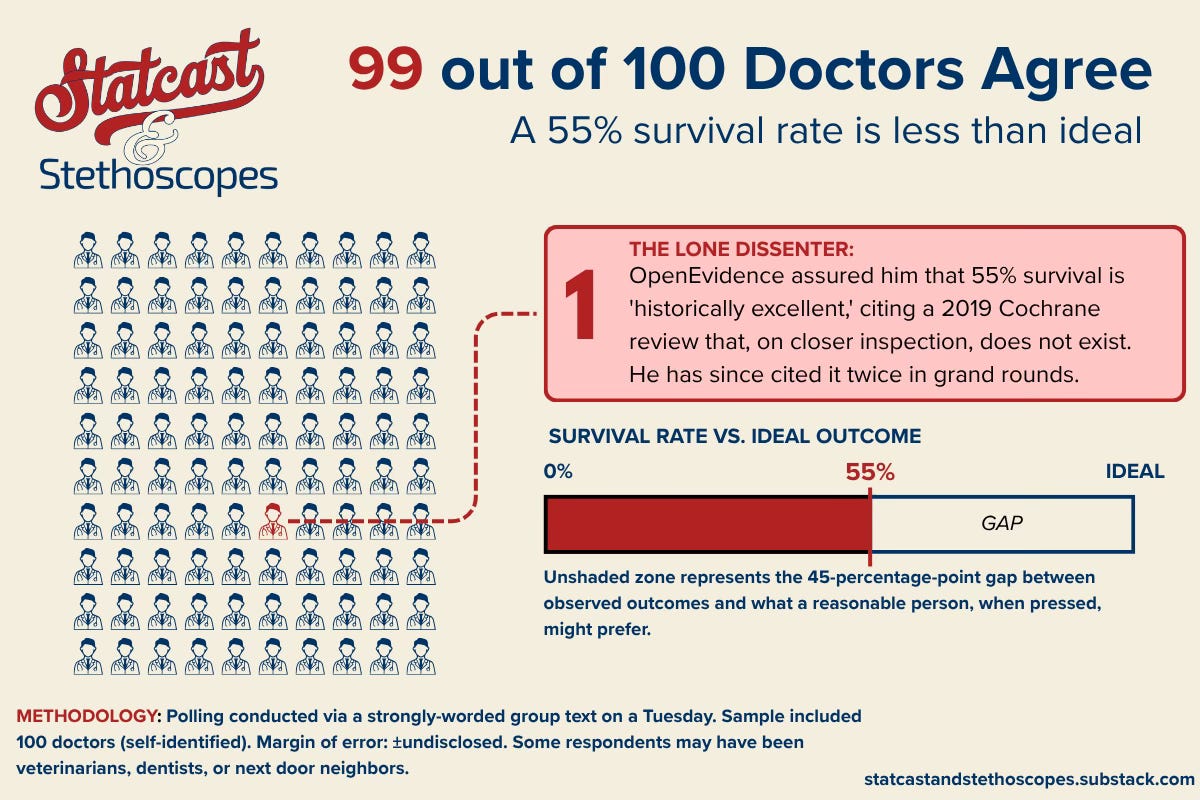
A 2024 study of 75,000 Substack newsletters found that 45% of them were just plain dead. Having a little better than a coin flip’s chance of surviving isn’t exactly a promising start. The experts agree: a highly unscientific Statcast & Stethoscopes poll found that 99 out of 100 doctors believe a 55% survival rate is, in fact, less than ideal.
And what was the prior probability that there would even be an audience for a Substack like this? I’ll be the first to admit that mixing baseball analytics and medicine is at least as intuitive as putting mustard on an Oreo. And yet, according to some deeply concerning corners of the internet, that apparently works too.
So if you’re reading this right now, that means you’re a unique individual — and there’s a pretty good chance that you’d enjoy a thin smear of Grey Poupon on your Oreos.
Another symptom of my insanity was that I thought writing would be easy. I told myself, “Bobby, you’ve written multiple articles for academic journals and at least a handful of well-worded emails. Writing for Substack is not that hard. Tell him, Wash.”
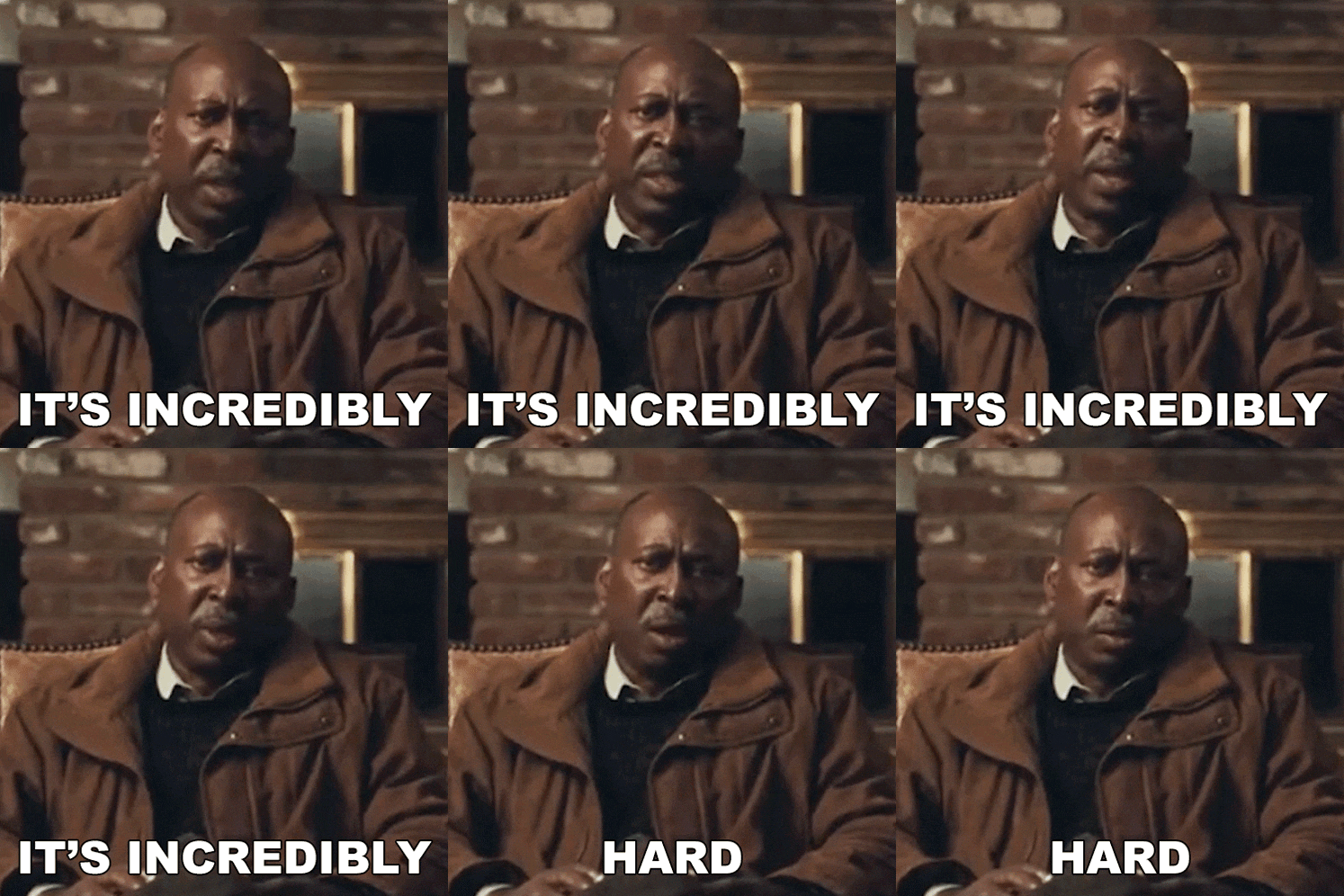
*Sighs* You were right, Ron Washington. You’re always right.
So what if it was crazy to start this newsletter? I’m a year into it now, and there’s no turning back at this point.
(The astute reader might flag this as an example of the sunk cost fallacy — and to you, wise reader, I award fifty Kahneman points!)1
But if I follow my own advice and take a Bayesian approach, I need to update the priors based on new evidence that came in — most of which I didn’t see coming.
While I’ve always understood that the odds of becoming the next Atul Gawande were infinitesimally small, I didn’t anticipate how writing on Substack would change the way I thought about myself. Despite my jokes a few paragraphs earlier about my professional writing experience, I’ve never felt like a real writer.
But after a year of consistently putting words out there, I think I can call myself an honest-to-goodness writer. Sure, I may have established myself as the oddball doctor writing in baseball analogies, but hey — I’m a writer!
And then there are the unexpected connections. Writing on Substack has allowed me to interact with and learn from some truly talented writers in both medicine and sports. Some have even recommended me to their audiences.
Plus, I think that writing about uncertainty, evidence interpretation, and clinical reasoning has made me a better doctor. One thing about writing is that it forces you to think deeply about your ideas. Doing this regularly has brought clarity to my decision-making, teaching, and communication that I wouldn’t have developed otherwise.
These things are bigger than any objective analysis could have captured a year ago, something I think Bayes himself would have understood.
A less commonly known fact about Thomas Bayes is that he was a Presbyterian minister who believed that the probabilistic manner in which our world seems to operate is a reflection of a divinely ordered world — one that we gradually understand more deeply as new evidence arises2.
For Bayes, probability wasn’t a sign of chaos. It was a framework for better understanding the big and important things in life.
And so many of those things are improbable.
This past weekend, my family and I were invited to watch a Charlotte Knights game. Charlotte is the AAA affiliate of the Chicago White Sox. It was a hot afternoon for baseball, and eventually my 9-month-old son decided he’d had enough of the heat.
We were there for a corporate event, and fortunately our tickets included access to the suite-level concessions and bathrooms. I thought a walk through the air-conditioned hallway might help him fall asleep so I could go back and watch the game.
There I was, casually strolling the hallway, and looking at old team photos and jerseys on the walls. My son was quiet now (nailed it) and suddenly, standing in front of me, there was Hall of Fame manager Tony La Russa.
I caught his attention. I asked an idiotic question: “Are you Tony La Russa?” (Of course, he was.)
I stammered through an explanation of my being a lifelong Cardinals fan (La Russa managed the Cardinals to World Series wins in 2006 and 2011), and how honored I was to meet him.
Despite having been waylaid by a bumbling stranger with a baby, he was uncommonly gracious. He told me which suite he was watching the game from and invited me to come back later if I wanted him to autograph something.
I couldn’t believe my luck. I rushed back to share my experience with my wife and kids.
I did go back to his suite a bit later — this time with my two oldest kids (ages 12 and 10) in tow.
Reluctantly, I opened the glass door, poked my head through with my hand raised as if to say, “Hey, do you remember me — the big doofus with the baby?”
He remembered me. He welcomed us in and introduced me to his guest, whom I didn’t immediately recognize, but who just so happened to be former Cardinals manager Mike Shildt.
Incredible. Here I am, diehard Cardinals fan, hanging out with two former Cardinals managers in a luxury suite at a minor league baseball game.
We chat for a few minutes. Tony is especially engaging with my kids — particularly in answering my son’s question of how he felt after David Freese’s legendary walk-off home run in Game 6 of the 2011 World Series.
Then we line up for a photo, and all of a sudden, Tony says, “Wait a second, if we’re gonna do this, we’ve gotta do it right.”
He turns to my 12-year-old son, pulls off his 2006 World Series ring, and tells him to put it on.
I’m absolutely floored. My son’s grinning with excitement, but he cannot fully grasp the rarity of the moment.
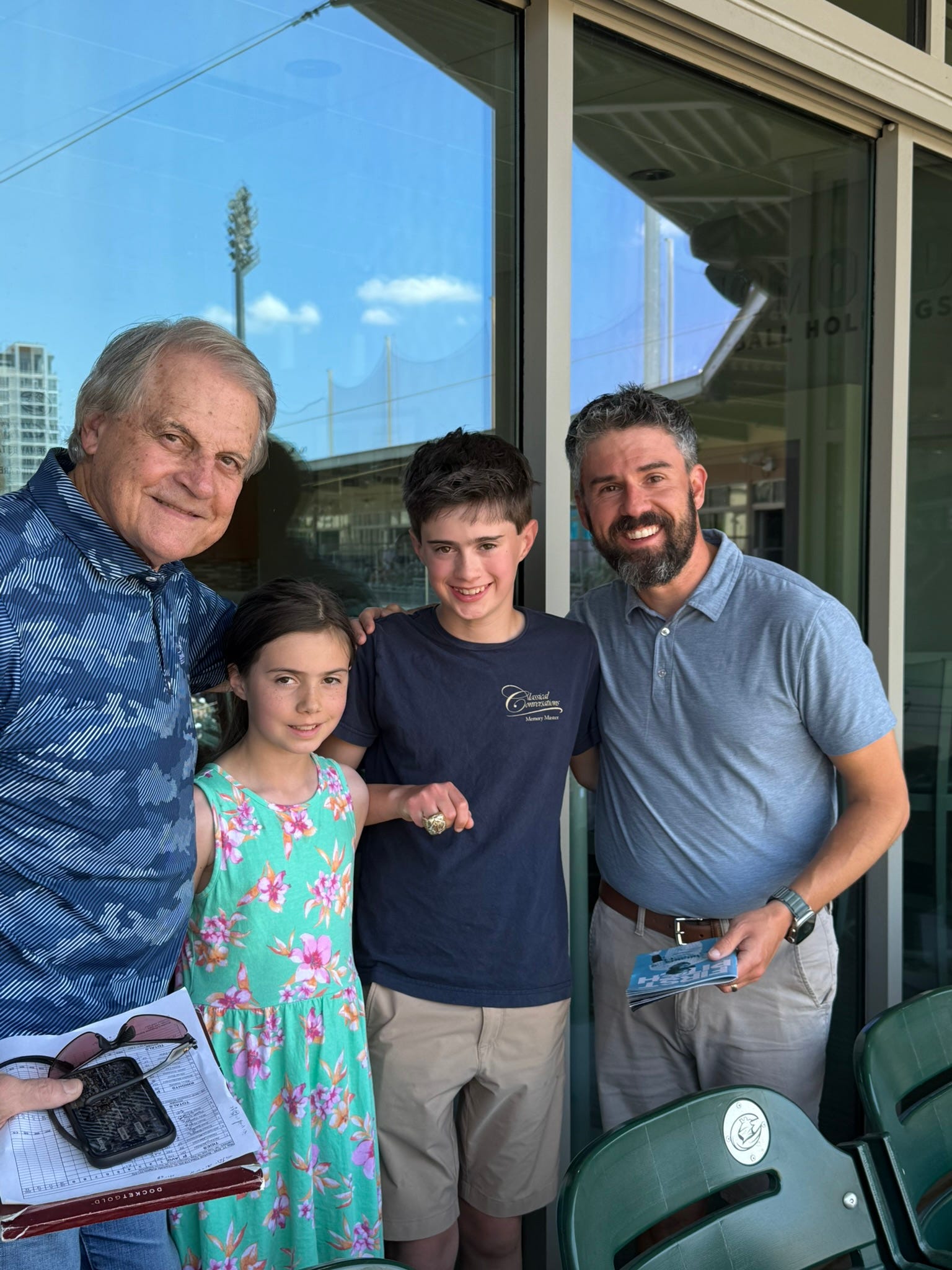
We take our photos, chat a bit more, and not wanting to overstay our welcome, we politely excuse ourselves.
An event like this could never be captured by a model. It was far too improbable — the big moments are often like that.
It’s being down to your last strike (twice) and coming back to win one of the greatest World Series games in history while a hometown kid transforms himself into a franchise legend.
It’s the unexpected connections made from simple choices, like starting a newsletter or taking a walk to soothe a crying baby.
It’s taking your family to a baseball game — and walking away with an experience that will forever deepen the bond between father and son.
Perhaps I should have done a bit more analysis before clicking publish on that first article. But I’m glad I didn’t — now that I know what I would have missed.
Sometimes, it’s better just to see what happens. We live in a probabilistic world, where the seemingly improbable happens all the time.
We can’t predict when those moments will happen. And they can only be experienced if we choose to show up.
Which is, of course, a very Bayesian way of thinking.

1 Kahneman points can be redeemed for merchandise in the official Statcast & Stethoscopes store just as soon as it exists.
2 See The Signal and the Noise by Nate Silver, Chapter 8.
Some of the best swings are the ones you almost didn’t take.
If this piece made you think differently about base rates, improbability, and the value of just showing up, a like ❤️ or restack 🔁 helps this reach others wrestling with the same questions.
Plus, I’ve opened up the comments on this one. I’d love to hear about an improbable moment in your own life that never could have been predicted ahead of time.
You are a writer! The act of writing makes you a writer and doing it consistently for a year... That's all there is to it. Congrats on hitting your annual milestone and ready to read more!